

Operational Continuity for Institutional Staking
Why institutions need a resilient, custody‑controlled execution layer when validator operators fail.

Introduction
Institutional staking has matured rapidly over the last years, becoming a foundational component of digital asset strategies. As infrastructure becomes more sophisticated - and as institutions scale their exposure across multiple networks - operational resilience has shifted from a best practice to a core requirement.
Despite this, most institutions still rely heavily on validator operators’ dashboards, APIs and orchestration services. These tools are convenient, but they represent a structural weakness: if the operator’s backend goes down, the institution’s ability to execute critical on-chain actions goes down with it. For an industry where timing and governance matter, this isn’t acceptable‑chain actions goes down with it
The Colossus Institutional Hub was designed to close this gap, providing institutions with a direct, custody-controlled execution layer that ensures they remain in full control - even when their primary operator is unavailable controlled execution layer that ensures they remain in full control‑controlled execution layer that ensures they remain in full control.
Provider dependency as a Single point of Failure
Institutional staking ecosystems depend heavily on dashboards, APIs, and orchestration tools provided by validator operators. While these platforms streamline operations, they also become a single point of operational vulnerability. If the operator systems experience outages, security incidents, maintenance related downtime or API degradation, institutions may temporarily lose access to essential functions such as exit requests, withdrawals, or credential updates. This interruption weakens operational agility and risk management processes‑related downtime or API degradation‑management processes.
The Institutional Hub addresses this by enabling direct on-chain execution without relying on the operator’s proprietary tooling‑chain execution without relying on the operator’s proprietary tooling.
A custody controlled, chain aware execution layer‑controlled, chain‑aware execution layer
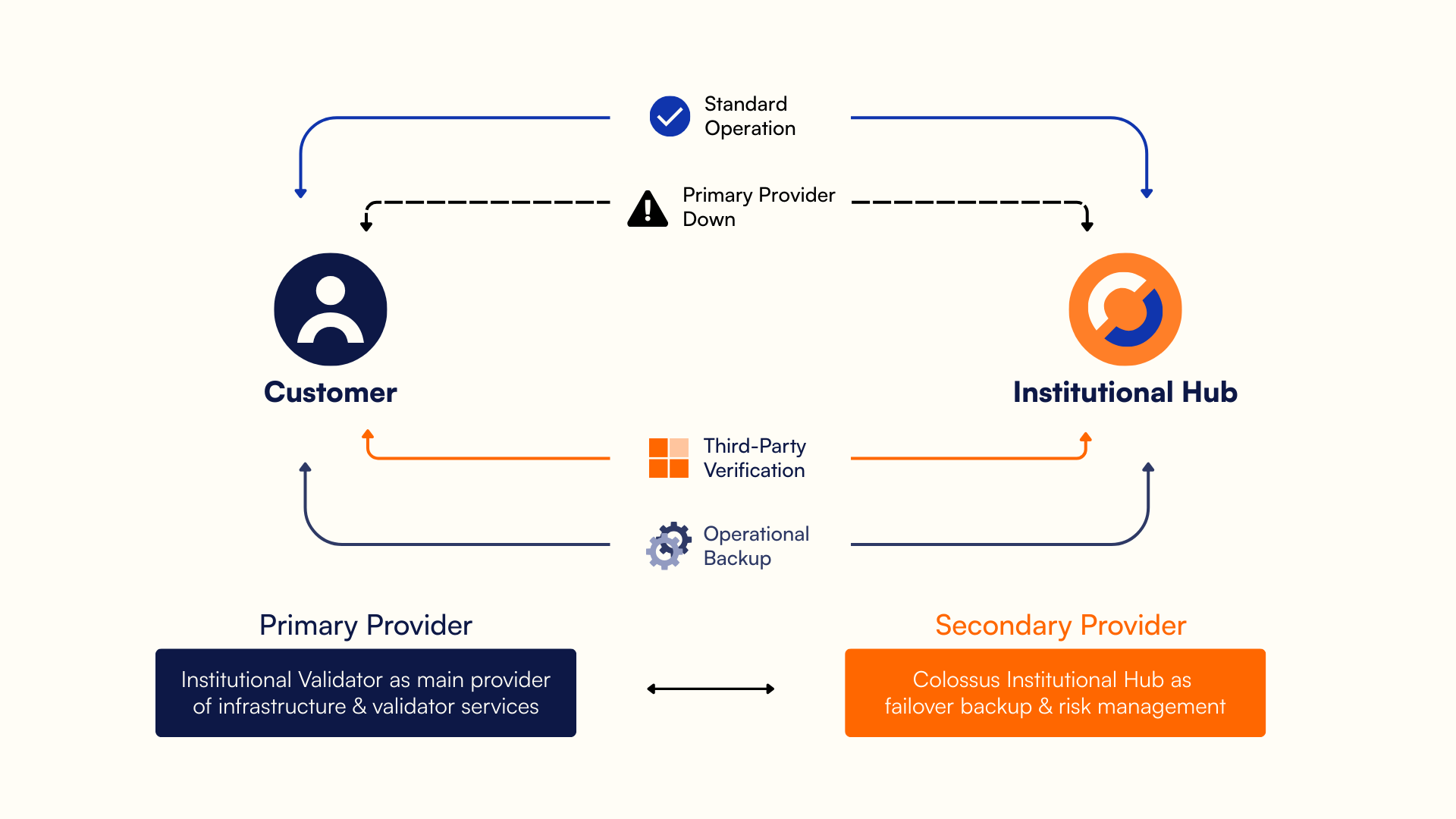
The Institutional Hub acts as an independent orchestration system that connects directly to institutional custody solutions such as Fireblocks, Ledger Enterprise and Dfns. No operator UI, browser extension, or proprietary API is required.
Transactions are constructed by Colossus.
They are signed inside the customer’s MPC/HSM custody environment.
Execution happens directly on-chain, independent of the provider’s tooling.
Clients maintain full governance alignment, as the Hub preserves native approvals, whitelists, and internal controls. Users can also review human readable intent and raw transaction fields before signing - reducing execution risk and preventing unintended approvals‑readable intent.
Two core capabilities for operational resilience
Backup execution path
When a provider suffers a security breach or becomes unreachable, institutions must act quickly to mitigate exposure. With the Institutional Hub, they can continue operating without relying on the primary provider.
Institutions can seamlessly execute:
undelegation workflows,
withdrawals or redelegations,
risk reducing asset movements during incidents‑reducing asset movements during incidents.
This ensures continuity and minimizes potential slashing exposure, even when primary infrastructure is compromised or offline.
Independent transaction verification
Even when institutions are using an operator tooling, the Hub offers an additional security layer. It:
decodes operator generated transactions‑generated transactions,
recomputes them independently,
allows the user to verify the correct transaction hash before signing.
This independent verification step mitigates the risk of compromised or altered transactions originating from third-party systems and strengthens the institution’s internal controls‑party systems and strengthens the institution’s internal controls.
Managing Ethereum validators during operator outages
Ethereum offers a practical example of why continuity matters.
Under normal circumstances, institutions rely on an operator’s dashboard to request validator exits, process withdrawals, or update credentials. But if the operator’s tooling becomes unavailable exactly when an exit is required—because of liquidity needs, risk considerations or governance decisions - the institution may be effectively locked out.
With the Institutional Hub, they aren’t.
By connecting their custody wallet directly, institutions can trigger all relevant on-chain operations, including full withdrawals, partial withdrawals, consolidations, and credential updates from 0x01 to 0x02. The Hub also supports Pectraera operations, including batch flows enabled by EIP7702. This ensures uninterrupted control without changing governance procedures or custody level protections‑chain operations, including full withdrawals, partial withdrawals, consolidations and credential updates from 0x01 to 0x02. The Hub also supports Pectra‑era operations, including batch flows enabled by EIP‑7702‑level protections.
Why the Institutional Hub matters for Asset Managers and Institutions
The strength of the Institutional Hub lies in its alignment with existing governance frameworks. Institutions do not need to introduce alternative signing methods, modify custody workflows, or alter approval policies. Instead, they eliminate a major operational vulnerability by ensuring that staking actions remain possible at all times. With broad multichain support and custody embedded security, the Hub transforms staking continuity from a fragile dependency into a guaranteed capability, allowing institutions to operate with confidence even under adverse conditions‑chain support and custody‑embedded security, the Hub transforms staking continuity from a fragile dependency into a guaranteed capability, allowing institutions to operate with confidence even under adverse conditions.
Conclusion
As staking becomes a core component of institutional asset management, operational resilience is no longer optional. The Colossus Institutional Hub redefines an operational control by removing reliance on external operator tooling and enabling institutions to act directly on chain, securely and consistently. Whether during normal operations or in moments of incident response, the Hub ensures that institutions remain in full command of their staked assets.
In an environment where timing, transparency and control can shape both financial outcomes and risk exposure, this operational independence is not merely useful - it is essential.